
Reflections
Major 1
“Well, what are your thoughts Priya?” Professor Hank Greely asked. It was a simple question, yet the only ideas I could string together were reiterations of opinions from other people. I had prepared for the interview thoroughly — researching the scientific literature and surveying the prevailing views on embryo genome screening. Still, unexpectedly put on the spot, I failed to articulate my own perspective.
Greely pushed further, posing conceptual questions that forced me to consider the boundaries of the problem. The more I clarified my own thinking, the more I could challenge his. Those 90 minutes flew by as I delved into medical and ethical dilemmas and explored the implications of biotechnology from a societal, cultural, and economic lens. What began as my attempt to restate the “right” opinion became an opportunity to investigate what I actually believed in and understand why those beliefs mattered.
The more I examine why I'm inclined to hold a certain opinion, the more attuned I become to whose voices dominate a narrative and whose are left out. Through journalism, I've learned to ask myself who benefits from a popular narrative and who does not. This awareness has taught me to recognize silence as a unique signifier of where power is being held. We see this play out in the novel All the President’s Men and right next door at the Stanford Daily.
I saw this dynamic clearly when my co-reporter and I decided to interview two teachers who had refused to sign a letter opposing the adoption of a new math course at Paly. Both were visibly reluctant to share their views, as their actions were in the minority, and one declined to speak on the record at all, fearing professional repercussions. As student journalists, we have protections that other teachers or even professional reporters don't always enjoy. I've learned that reluctance isn't a reason to back away from a story — it's often the clearest sign that the story matters.
In addition to learning to think critically and listen for what isn't being said, through journalism, I’ve also learned how to be an effective leader. When I scrambled to pull together a Tiny Desk Spark Grant proposal — an idea I had formed just hours before — our team’s excitement was enough to win us the funding. But producing the actual videos would prove harder than first anticipated. It took us three months to film, and two more months to publish our first video. I had mistaken enthusiasm alone for real leadership. I hadn't articulated clear deadline expectations or responsibilities, and the bulk of the editing fell on one person's shoulders.
I changed course. I started holding regular check-ins, creating timelines, and assigning specific tasks. Through trial and error, I learned that motivation isn't about rallying people around my vision, but about helping them see how their contribution shapes the final product. I made sure everyone understood not just what needed to be done, but why their work mattered to the story we were telling. When new members joined, I encouraged senior video editors to mentor them and oversee the team’s collective editing, which would lighten their workload and build investment. Leadership, I realized, is about creating space for people to lead alongside you.
From discussions with teammates to reluctant teachers and curious bioethicists, journalism has taught me to ask better questions of others, power structures, and most of all myself. There is no doubt I will use these skills in my life beyond high school, in a college publication, or even a professional journal. Until then, I’ll continue to pursue the conversations and stories that challenge me and complicate the easy answers.
Major 2
There is a specific kind of overwhelm that comes with being a teenager right now. The news arrives constantly, most of it about decisions made by people who are not thinking about you, and the natural response to that volume for many young people is to tune out. I have, and continue to feel that pull. What journalism gave me, first, was a way to continue to pay attention and a set of tools for how to ask questions. What it gave me this semester was a clearer understanding of why that attention needs to be persistently practiced and shared.
In February, I covered a protest outside Paly where community members dressed in the red cloaks and white bonnets of Margaret Atwood's The Handmaid's Tale to demonstrate against what they described as democratic backsliding. One organizer asked not to be identified by her last name, in fear of administration retaliation. Stan Chism, a retired physician who attended, said he came to draw attention to what he saw as a real threat to democratic institutions. The location, right at the crossing between our school and Town and Country, was deliberate. They wanted students to see it.
What I kept thinking about while reporting that piece was how much effort these adults were putting into reaching young people who might not otherwise be paying attention. That felt worth sitting with. There's a version of civic participation that assumes young people are apathetic. The protesters didn't seem to believe that. They showed up at a high school crosswalk on a Friday afternoon in costume because they thought it mattered whether we saw them.
Reporting the Mirabelli v. Bonta story a few months later, I ran into the same dynamic from a different angle. The Supreme Court's ruling on student gender identity confidentiality created real uncertainty for PAUSD, and I wanted to understand what that uncertainty actually looked like in practice. Robert Andrade, the district's civil rights and legal affairs coordinator, walked me through where the law stood, why the district was waiting on the Ninth Circuit before changing anything, and what the tension between parental rights and student privacy actually meant for staff. That kind of sourcing matters. Most students don’t see a need to seek out a conversation with the district's legal coordinator. Reporting gives me a reason to, and a way to bring what I learn back to people who deserve to know it.
The harder part of that story was talking to sources. Students, teachers and community members alike asked for anonymity. One student who identified as transgender, cited concerns about safety under the current federal administration's stance on gender. That's not a small thing to navigate as a reporter. Getting it wrong means a real person is exposed in a way they didn't consent to. Getting it right means the story is harder to tell, less specific and sometimes less compelling on the surface.
In All the President's Men, Woodward and Bernstein faced a version of this repeatedly. Sources were afraid. People with direct knowledge asked not to be named, or wouldn't confirm things on the record at all. What the book made legible for me was how much of serious journalism is the work of protecting people while still finding a way to tell the truth. Both the protest piece and the trans legislation story involved sources who were worried about retaliation in different ways. This reflects something about the current climate for speech, and it extends to student journalists in ways the SPLC has been documenting for a while now. I was beginning to see, first hand, how the chilling effect was working its way through the voices of Palo Alto.
I reached out to the SPLC this semester because I had questions about platform ownership and editorial independence in the context of the journalism app my partner and I were building. My partner and I are both minors, which meant we couldn't hold an Apple Developer account. Whoever held it would have some degree of control over the platform, and that matters significantly editorially. Jonathan Gaston-Falk, a staff attorney at the SPLC, responded with detailed guidance on our terms of service, flagging places where our language overstated our legal protections and others where it could be tightened to better reflect how the app actually functioned. What Gaston-Falk's response made clear was that the protections student journalists rely on do not automatically extend to the platforms they build. The app existed in a different legal category than the publication itself, and the terms of service had to reflect that carefully.
Sitting with his answers and reading the fine print on data privacy requirements for educational apps pushed me to think more carefully about what it means to ask users to hand over information in exchange for access to student journalism, and how much editorial independence depends on seemingly background decisions. Watching the SPLC treat a high school student's terms of service as worth careful legal attention made me realize that our student press protections exist because people fought for them, and they require persistent maintenance to hold.
Along with legal protections, one thing I have come to believe is that the most effective response to a chilling effect is continued, deliberate speech. Earlier this semester, I covered a youth athlete mental health panel at Stanford where Steve Young, Andrew Luck and others spoke to students about performance anxiety and loss. The panel took on a different weight given what our school community had experienced that week. The room and discussion gave the community a way to think together about something it might otherwise have only felt privately.
That is the function I keep returning to. A student publication is a public forum, one of the few genuinely student-owned spaces where the terms of discussion are not set by administrators or algorithms. Whether the story is a Supreme Court ruling, a parcel tax, a math curriculum controversy or a panel on mental health, the act of reporting it gives a community’s anxieties a place to be confronted by action. I think that is a necessary condition for civic and democratic health. I think student journalists, precisely because they feel that pull to tune out and choose not to, are often the most important people positioned to do that work well.
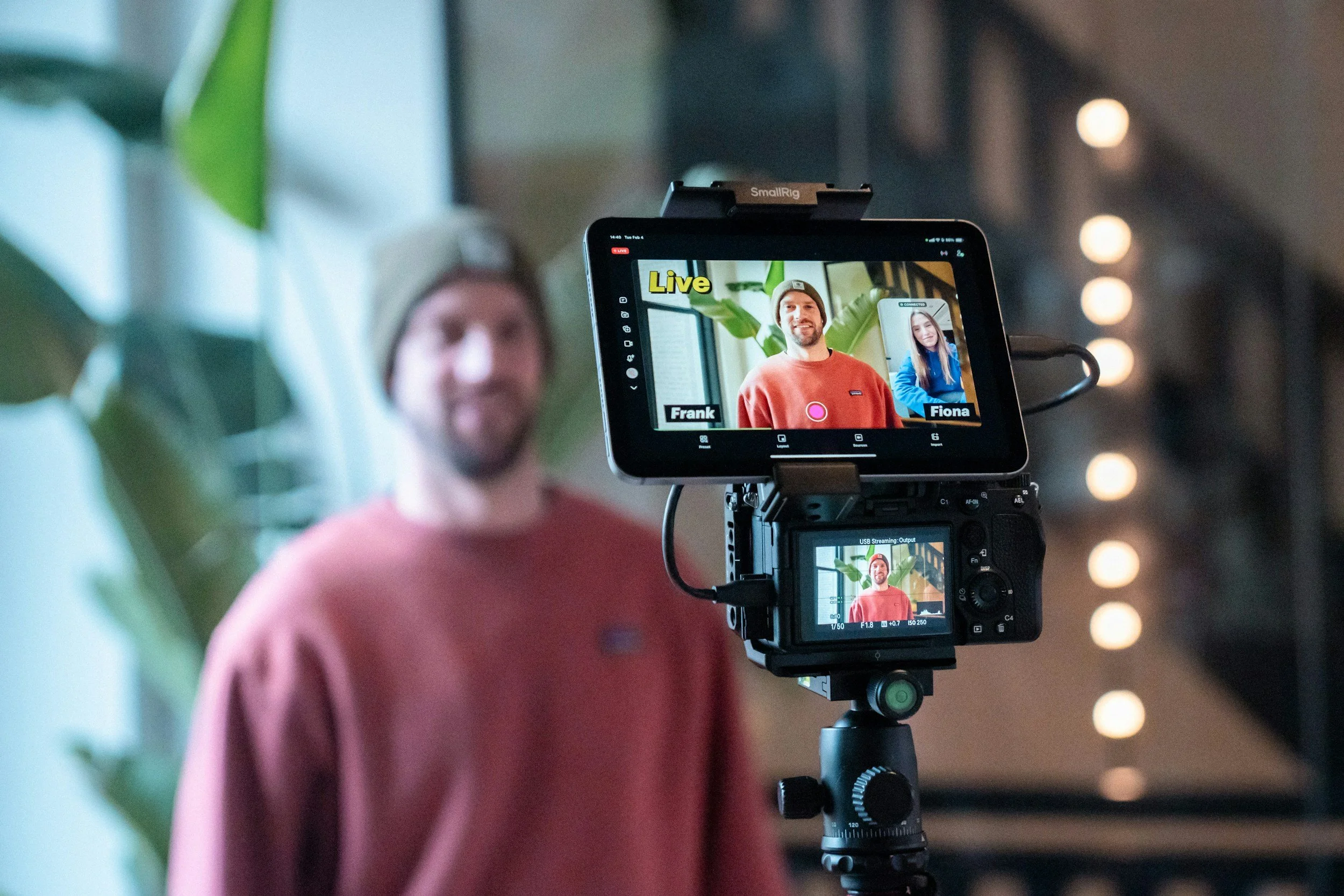
Guiding a story through what, where and how I choose to film.
In broadcast journalism, you aren’t able to explicitly insert your own thoughts into concrete sentences. Instead, you must direct a watcher’s attention to what you believe to be the most important aspect of your project. In our first Tiny Desk package, the video lacked depth, character, and most crucially — an angle. I found that it is not enough to simply point a camera towards talent and hope the audience cares. You must be intentional. For our following features, I sat down with each artist to understand — not just their talents — but also their personality and purpose. When we filmed, our location, camera techniques, and editing were all deliberate attempts to encourage the audience’s focus toward the story and uniqueness of each artist.

App development
How many hours can you stare at the same error message before admitting defeat? Through the process of designing The Paly Voice’s mobile app, I spent weeks nursing countless fundamentally broken architectures, convinced the next fix would work. The app was partially functional, which kept me trapped longer than complete failure would have. Starting over required confronting an uncomfortable truth: I had failed. Over. And over. Again. I learned that real problem-solving sometimes means having the wherewithal to walk away from work you're invested in, and quietly, courageously, start again once more.
Law, Ethics, and News Literacy
Covering the Nov. 18 Stanford Daily v. Marco Rubio hearing was eye-opening. Professor Michael Meyerson coined the term “collateral censorship” to describe the government's ability to silence speech, not by prohibiting it, but in this case, by using immigration enforcement as a mechanism to punish legally protected political expression - what the case refers to as “the chilling effect”. Talking with the Stanford Daily students afterward, I saw how deeply they understood something I was only beginning to grasp. This experience taught me to recognize the relationship between law and journalistic access. Laws that appear to have nothing to do with the press, like immigration statutes and visa regulations, can crucially influence whose stories get told and whose do not.

Editing
under construction
Team building
under construction